Guide 03
Sheffield Park and Garden was built for this exact month
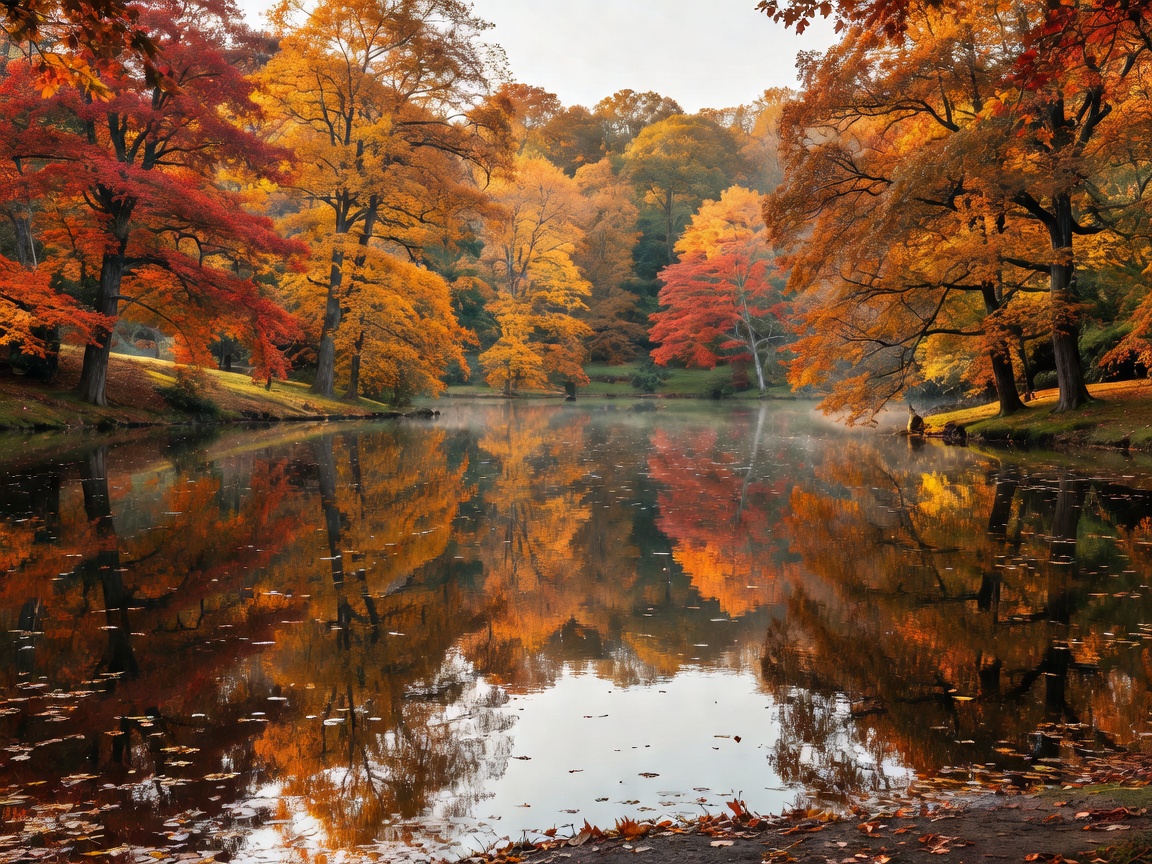
Most gardens acquire good autumn colour as an accident of what happened to be planted. Sheffield Park and Garden, in East Sussex, has it because someone went out of their way to arrange it — a rare case of a landscape's most photographed feature being entirely intentional.
How it got this way
The garden's structure, including its chain of four interlinked lakes, dates to work associated with Capability Brown and later Humphry Repton in the eighteenth century, commissioned for the Earl of Sheffield. That gave the site its bones. Its colour, though, is largely down to Arthur G. Soames, who took on the garden from 1909 and spent decades planting it specifically for autumn: maples, tupelos and swamp cypress chosen and positioned so their reflections would double across the water. It is now cared for by the National Trust.
What to actually look for
The swamp cypress, Taxodium distichum, turns a rust-orange unusual among British-grown conifers and stands directly at the water's edge in several spots, which is what produces the strongest reflections. Look too for tupelo (Nyssa sylvatica), whose leaves run through red before most other species have started, and the many Acer varieties planted for a longer, staggered colour season rather than a single peak week.
Getting there
The garden sits near Uckfield in East Sussex, with the nearest mainline station at Haywards Heath and bus connections onward, or a direct approach for anyone arriving via the Bluebell Railway, a heritage steam line that terminates at Sheffield Park station on the garden's boundary — arguably the most in-character way to arrive.
How it compares with Westonbirt
Westonbirt, the National Arboretum in Gloucestershire, is the other big name in planned English autumn colour, and it makes a useful contrast. Westonbirt is larger and holds a substantially bigger collection of Japanese maples, which draws heavier crowds on peak weekends. Sheffield Park is smaller and organised around water: its lakes give it a mirrored, doubled quality that a dry arboretum can't replicate, at the cost of a narrower plant collection overall. Neither is more "authentic" than the other — both are curated landscapes built for this display, just built differently.
Practicalities
As a National Trust property, entry is ticketed, with the usual member/non-member pricing structure and current rates best checked directly before visiting rather than assumed. Paths around the lakes can flood or turn slick after rain, and the busiest color weeks draw enough visitors that an early or midweek visit noticeably improves the experience.
Good to know
Because the colour display depends on staggered planting rather than a single species turning at once, the "best" week shifts a little year to year with the weather — there is no fixed date to aim for, only a general window through October into early November.