Guide 04
Wistman's Wood is an oakwood that stopped growing up
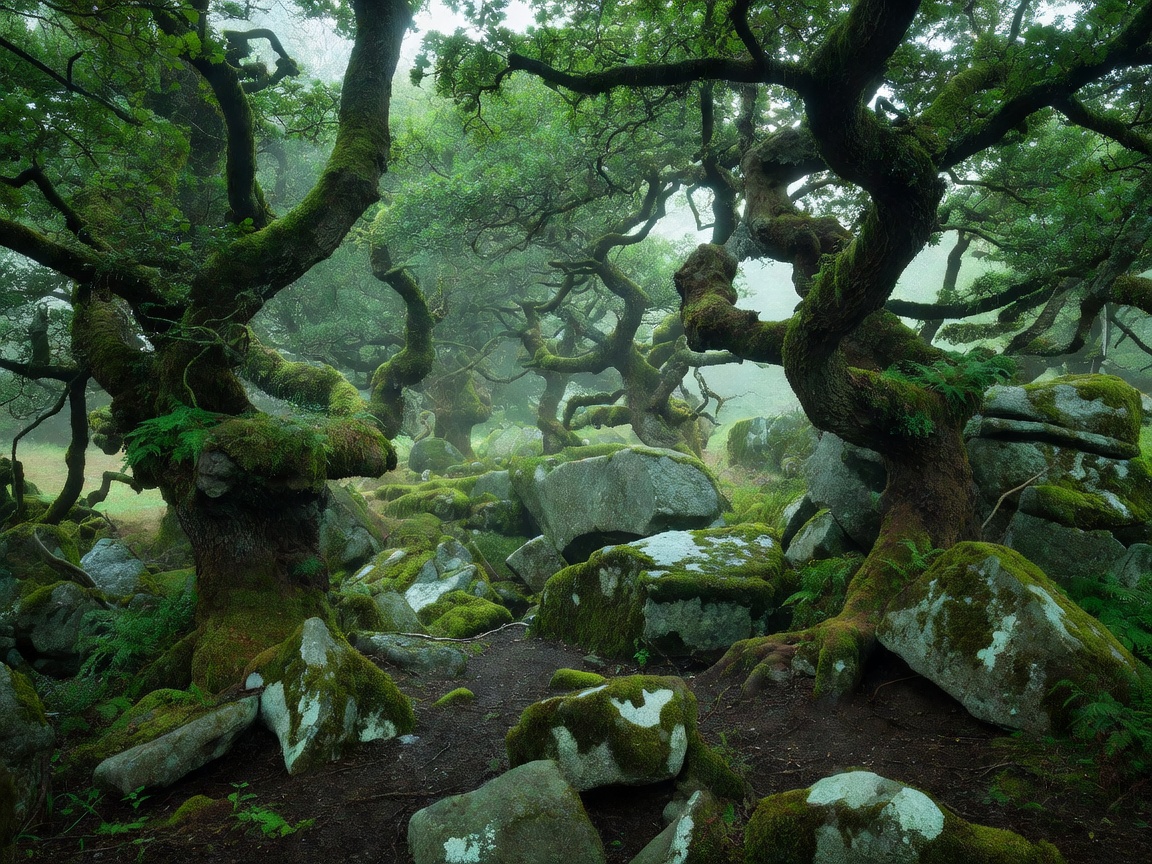
On Dartmoor, at around 380 to 400 metres above sea level, sits a wood made of trees that any forester would call stunted and any visitor tends to find slightly unsettling. Wistman's Wood is a block of ancient pedunculate oak (Quercus robur) rooted directly among granite boulders, none of the trees more than a few metres tall despite being genuinely old.
Why it looks like this
The stunted form isn't damage or deliberate management; it's exposure. Wind, thin acidic soil, and a granite boulder field called clitter make it physically difficult for the oaks to grow tall, so instead they've grown low, twisted and dense over a very long timescale. It is one of only three surviving high-altitude oakwoods on Dartmoor, alongside Black Tor Copse and Piles Copse, and is designated a Site of Special Scientific Interest for exactly this rarity.
The moss is the point
Every trunk, branch and boulder inside the wood is coated in a thick layer of moss and lichen, thriving on the moor's near-constant damp air. The effect in autumn, when low mist sits over the moor for long stretches, is a wood that muffles sound and light in a way lowland woodland rarely does. It photographs oddly flat and doesn't fully translate — the atmosphere is more about temperature and quiet than anything strongly visual.
Folklore, briefly
West Country tradition ties the wood to the Wisht Hounds, a spectral pack said to hunt the moor, part of a broader body of Dartmoor ghost-story tradition that is widely thought to have fed into Arthur Conan Doyle's setting for The Hound of the Baskervilles. Whatever you make of that, the wood earns its reputation without needing the legend.
Getting there and moving around
The standard approach is on foot from the car park near Two Bridges, a walk of roughly three to four kilometres there and back across open moorland with no path once you reach the wood itself. Visitors are asked to stay on the perimeter rather than push in among the trees, since the moss layer that defines the site is easily and permanently damaged by repeated foot traffic.
How it compares
Set beside the New Forest's lowland ancient woodland, Wistman's Wood is a different category of thing entirely: not managed pasture-woodland but an exposed, high-altitude relic shaped by wind and rock rather than grazing or coppicing. It has more in common structurally with montane scrub found in parts of the Scottish Highlands than with anywhere else in southern England.
Good to know
Dartmoor's weather changes with little warning and mist can close in fast, so a map and compass or a reliable offline map matter more here than the modest walking distance suggests. The granite clitter underfoot is uneven and becomes slippery when wet, and mobile signal across this part of the moor is unreliable.